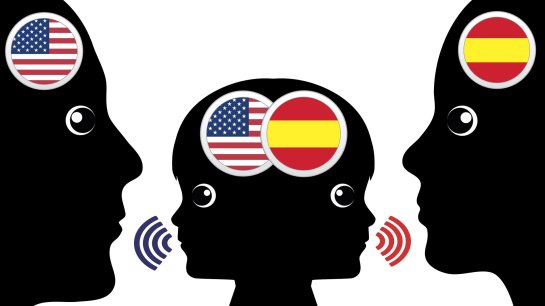
Bilingual-child

Why should foreign languages be taught in American schools? Studies often point out the cognitive benefits of bi- and multilingualism, but are these benefits so compelling that language requirements should be incorporated into school curriculums rather than being left to chance? Can bilingualism merely strengthen the ability to absorb new information or concentrate on difficult or brain-twisting tasks, or is there more to the benefits? What differences can be found between those who are monolingual versus those who are multilingual? 

While some might argue that any brain exercise might offer similar benefits to learning a second language, there is a great deal of research to support the argument that learning a second language is one of the best brain exercises you could choose. And you would be in good company if you did.

How Common is Bilingualism?

A survey by the European Commission (2006) recorded that 56 percent of respondents are capable of communicating in a language beside their mother tongue. Roughly 66 percent of the world’s population has been raised bilingual. So that doesn’t count those who learned a second or third language outside the home.

  • 99 percent of Luxembourgers were found to be bilingual, as well as 95 percent of Latvians.
  • one-fifth of Americans over the age of five were able to speak in a language other than English, a 140 percent increase in 2007 since 1980. 

Brain Benefits

Being able to balance between using two different languages requires use of executive functions (which develop with the part of the brain known as the prefrontal cortex). These are regulatory systems in the brain which involve practice of attention, reserve, and inhibition—in other words, self control. As the language systems in a bilingual or multilingual brain are consistently active at the same time, the person must rely on their executive control mechanisms when conversing and this constant practice of controlling the direction of their attention strengthens their executive control, a side-effect that will benefit them in many other areas of their life. Executive control is strongly correlated with emotional intelligence, for instance, a skill that may be as important is IQ in determining success.

Behavioral Control

While not every aspect of mental agility is better in bilinguals than monolinguals, in general, executive control consistently shows up in the correlations. This involves the ability to exercise conscious, cognitive control over aspects of behavior such as your attention, working memory, and your ability to inhibit impulses.

Conflict Management

Also, those who are bilingual typically perform better on conflict-management tasks. Clearly, conflict management engages executive function. When participants were provided a series of images showing color names (such as “red” or “blue”), which appeared in mismatching colors (the word “red” might have been colored green for instance), those who were monolingual did significantly worse in smoothly naming the color of the word, instead of the irrelevant word itself. Bilingual participants were better able to ignore the irrelevant word and correctly communicate the genuine color of the image.

Their ability to fluently employ “additional resources” of the brain that assist in ignoring the context of the word and instead focus on the actual color of the word is called inhibitory control, and is much better developed in those who speak two or more languages.

Mental Agility

A third area where the research shows strong benefits is in problem-solving skills and creative thinking. Dr. Fraser Lauchlan, a researcher from the University of Strathclyde in Scotland, commented that bilingualism can have “demonstrable benefits, not only in language but in arithmetic, problem solving and enabling children to think creatively.”  In a study of primary school students, there was a clear difference in performance between bilinguals and monolinguals. “We also assessed the children’s vocabulary, not so much for their knowledge of words as their understanding of them,” said Dr. Lauchlan. “Again, there was a marked difference in the level of detail and richness in description from the bilingual pupils.”

Limitations of the Research

Whenever you’re publishing or considering research, it’s important to take note of the limitations of the findings. In the case of bilingualism, while the majority of published studies support the bilingual advantage, there are a few published studies that either challenge the advantage, or fail to support it some aspects of it. In fact, one group of researchers has suggested that perhaps preference is given by publishers to studies that support the advantage. That said, the peer review process is meant to weed out studies that are flawed or don’t fully follow the scientific method.

Still, as in any research topic, studies that aren’t flawed that present challenges to the bilingual advantage are just as important as supporting studies, because they may give important information that would help researchers figure out which situations encourage the advantages of bilingualism and which situations minimize the advantage. Since 36 percent of the challenging studies were actually published (compared to 63 percent of the supporting studies), there is a fair bit of research on both sides to weigh. When this is done, the interesting thing that comes out is that studies that challenge the advantage usually aren’t measuring tasks that involve self control. So the benefits to executive functions seem to have the strongest support.

That there IS an advantage of some sort, does seem to be clear. And while more research is needed to figure out all the ins and outs, the majority of the research supports the argument that there are indeed a number of advantages to be gained from learning more than one language. And these seem to be in areas that support some of the most important foundations of personal growth and success.

REFERENCES:

  1. Viorica Marian and Anthony Shook, in “The Cognitive Benefits of Being Bilingual.” Cerebrum: The Dana Forum on Brain Science. The Dana Foundation, 31 Oct. 2012. Web. 09 May 2017
  2. Cristina Crivello, Olivia Kuzyk, Monyka Rodrigues, Margaret Friend, Pascal Zesiger, and Diane Poulin-Dubois, “The effects of bilingual growth on toddlers’ executive function.” Journal of Experimental Child Psychology, Volume 141, January 2016, Pages 121-132.
  3. Margarita Kaushanskaya and Viorica Marian, “Bilingualism reduces native-language interference during novel-word learning.” Journal of Experimental Psychology: Learning, Memory, and Cognition, Vol 35(3), May 2009, 829-835.
  4. Fraser Lauchlan, , Marinella Parisi, Roberta Fadda, “Bilingualism in Sardinia and Scotland: Exploring the cognitive benefits of speaking a ‘minority’ language.” International Journal of Bilingualism, vol. 17, 1: pp. 43-56. , First Published April 16, 2012.
  5. Diane Poulin-Dubois, Agnes Blaye, Julie Coutya, and Ellen Bialystok, “The effects of bilingualism on toddlers’ executive functioning.” Journal of Experimental Child Psychology, Volume 108, Issue 3, March 2011, Pages 567-579.
  6. Susanne Ayers Denham, Hideko Hamada Bassett, Erin Way, Melissa Mincic, Katherine Zinsser, and Kelly Graling, “Preschoolers’ emotion knowledge: Self-regulatory foundations, and predictions of early school success.” Cognition and Emotion, Volume 26, 2012 – Issue 4.

Interested in more research related to education and learning?

famous-rejected

Jerry Seinfeld, Steve Jobs, and Steven Spielberg are just a few celebrities who faced early rejection and overcame it to realize exceptional achievements.

24 January 2017—At some point, be it among projects or schoolwork, exclusive friendships or love interests, you’ve faced one of humanity’s most extreme fears—rejection. It’s not easy to argue against the fact that rejection hurts. The word itself is almost an onomatopoeia. The sound of it reflects that gut-wrenching feeling that arises when it happens to you. However, rejection is not always a bad thing, and people don’t often acknowledge the long-term benefits of being able to deal with rejection. Ultimately, openness to rejection is necessary and beneficial to build up emotional resilience and help to inoculate us against the extreme effects of disappointment.

By standard definition, resilience is the ability to bounce back from adversity. How can you learn to bounce back if there’s never any adversity? A study titled, “Whatever Happened to ´What Might Have Been?´” (Hicks & King, 2007), coordinated by researcher Laura King at the University of Missouri, acknowledges the positive impact an unpleasant loss or rejection can have on us if we take the time to reflect on and embrace the negative experience. Those who allow themselves time to think about their losses and respond to rejections in ways that are “mindfully present to their negative feelings” are, in the long run, more likely to build up a stronger emotional and rational maturity and obtain happiness.

By avoiding (progress based on a fear of) rejection, negative and less resilient responses to undesired trials could potentially be more common, if we are not able to confront a negative situation. Allowing yourself to reflect on the disappointment and general negative emotions that frequently accompany rejection can also allow for you to be more appreciative and sensitive to the happiness you feel later on, desensitizing the idea of rejection into a natural life experience that makes way for maturity and overall mental resilience.

As your emotional maturity grows, so does your ability to empathize. By opening yourself up to social scenarios that risk rejection, you are better able to recognize and familiarize yourself with the emotions others have after their (possibly very similar) trials. Scientists at the University of Chicago observed prosocial behaviors in rats, saying that social experience is what drives empathy in them, especially toward unfamiliar mice. “Prosocial behavior seems to be determined only by social experience,” claims Inbal Barthel, Ph.D., and leader of the study at the University. Your potential to sympathize, or even empathize with others is further increased by your range of social exposure.

In another study, Roy Baumeister likens the ability to strengthen self-control to a physical “strength-model,” saying, “Just as exercise can make muscles stronger, there are signs that regular exertions of self-control can improve willpower strength” (Rodgers, Sarria, Decety, 2014). Many other human capacities function on that principle: the more you can exercise resilience to the opportunity of rejection and allow a break for the ability to rebuild, the further you allow yourself to improve on the outcome and eventually desensitize the anxiety of taking action. The same goes with your brain’s capability to exercise empathy for a variety of perspectives and feelings.

In the same way that social exposure can improve upon empathy, it can also allow for you to be more open-minded towards others and their criticism. Situations that provide unexpected or undesired outcomes stretch your resilience and your empathy in the sense that they widen your perspective. Because of this, you will likely be able to accept others’ views and opinions. Reflecting on multiple personal trials helps to not only desensitize and move forward from the pain, but to move forward with an open mind that allows for us to learn to reflect neutrally and plan for the future by seeing how the constructive critique of others can motivate us to change or use the outcome to our advantage.

Open-mindedness is often the goal that is maintained when professionals practice exposure therapy. Exposure therapy is, by definition, “treatment that involves repeated real, visualized, or simulated subjection to or confrontation with a feared situation, object or a traumatic event or memory in order to achieve habituation.” This kind of therapy is commonly used to treat anxiety disorders, post-traumatic stress disorders, or general phobias and anxieties that are detrimental to progressing in our lives. More specifically, there is rejection therapy, which challenges you to confront rejection and incorporate it into your daily routine.

Jason Comely, a freelance IT, had constructed this sort of “therapy” after confronting his own, personal fear of being rejected. “I had nowhere to go, and no one to hang out with. And so I just broke down and started crying. I realized I was afraid. I asked myself; afraid of what? I thought, I’m afraid of rejection.”

Comely’s confrontation with himself led him to make a change to his daily routine, “I needed to get rejected at least once every single day by someone.”

Everyday, for one hundred days, Comely put an effort toward interacting with new people and setting himself up for rejection. It seems like a simple task, asking someone for a ride, or asking for a discount on something at the store everyday. But for most people, a fear of rejection is something that can easily stop them from being productive and getting things done. So naturally, it can be a challenge to approach someone new and ask something you’d usually never ask in fear of being humiliated. On the other hand, familiarizing yourself with the possibility of an unwelcome outcome will help keep an open mind to both a negative result, and alternative perspectives.

Of course, it is true that long-term ostracism can sometimes lead to more severe adverse responses, such as depressive symptoms or anxiety. In fact, a UCLA-led collaboration of psychologists report that rejection is registered much the same way by our brains as physical pain. “In the English language we use physical metaphors to describe social pain like ‘a broken heart’ and ‘hurt feelings,'” said Naomi I. Eisenberger, lead author of the study at UCLA, “Now we see that there is good reason for this” (Eisenberger, 2003). When it comes to registering and being conscious of exclusion, fMRI scans suggested that the brain has higher levels of activity near the anterior cingulate. This part of the brain is located in the center of the brain, responsible largely for also processing physical pain. Eisenberger explains, “There’s something about exclusion from others that is perceived as being as harmful to our survival as something that can physically hurt us, and our body automatically knows this.” The researchers theorize that it’s possible there’s some connection between the pain of social rejection and the importance of developing social bonds in many animals. It also further confirms how well-rooted and important our need for social connection and exposure is.

Despite this, newer research looks closer at the way our brains register social rejection, referencing the study mentioned prior. “Physical pain and social rejection do activate similar regions of the brain,” says Choong-Wan Woo, graduate student at University of Colorado, “But by using a new analysis tool, we were able to look more closely and see that they are actually quite different.” The upshot is that we feel social pain similarly to physical pain, but the mechanics are different enough that you can’t just take an aspirin and expect social pain to go away. Instead, you need to increase your resistance to it.

Rejection is inevitable. Throughout your life, you will face numerous experiences that will risk rejection or failure and you will no doubt become discouraged. Even so, being able to use that discouragement as an adversity to bounce back from is, in the long run, so much more valuable to your emotional resilience than avoiding rejection as much as possible.  

RELATED RESEARCH:

Does Rejection Hurt? An fMRI Study of Social Exclusion,” Naomi I. Eisenberger, Matthew D. Lieberman, and Kipling D. Williams. Science 10 October 2003

Separate neural representations for physical pain and social rejection,” Choong-Wan Woo,  Leonie Koban,  Ethan Kross,  Martin A. Lindquist,  Marie T. Banich,  Luka Ruzic,  Jessica R. Andrews-Hanna &  Tor D. Wager. Nature Communications 5, 17 November 2014

King, Laura A., and Joshua A. Hicks. “Whatever Happened to ‘What Might Have Been?‘” Fortnight 62.7 (1976): 625-36; American Psychological Association, Inc., Oct. 2007. Web.

Daniels, Bryan C. “What’s the Rush? Taking Time to Acknowledge Loss Is Not That Bad.” EurekAlert! AAAS, 19 Dec. 2007. Web. 03 Jan. 2017.

Fischer, Dennis. Science Fiction Film Directors, 1895-1998, McFarland & Co. (2000)

Pro-social behavior in rats is modulated by social experience,” David A Rodgers, Maria Sol Bernardez Sarria and Jean Decety. eLife

Right Supramarginal Gyrus Is Crucial to Overcome Emotional Egocentricity Bias in Social Judgments,”  Giorgia Silani, Claus Lamm, Christian C. Ruff, and Tania Singer. The Journal of Neuroscience, 25 September 2013.

Roy F. Baumeister, Kathleen D. Vohs and Dianne M. Tice, “The Strength Model of Self-Control,” in Current Directions in Psychological Science (2007)

Reducing Social Stress Elicits Emotional Contagion of Pain in Mouse and Human Strangers,” Loren J. Martin, Georgia Hathaway, Kelsey Isbester, Sara Mirali, Erinn L. Acland, Nils Niederstrasser, Peter M. Slepian, Zina Trost, Jennifer A. Bartz, Robert M. Sapolsky, Wendy F. Sternberg, Daniel J. Levitin, Jeffrey S. Mogil. Current Biology (2015), published online Jan. 15, 2015.

Dark-Legacy.jpg

9/11 left a large mark on not only America, but the world. The fear behind 9/11 is still ongoing, and has affected us in both negative and positive ways. Part of that fear has led many to jump to conclusions about how to prevent such a thing from happening again.

One of those conclusions—an erroneous one—is that if the terrorists were Muslim, then we must fear all Muslims. This expands to fear of all people from Middle Eastern descent, as well as religion in general.

However, religious extremists do not speak for all people with religious beliefs. Just as a small group of people originating from one race do not speak for all people descending of that race. Similarly, one group of Christians (such as the Westboro Baptist Church) doesn’t speak for all Christians.

The reason we tend to jump to these conclusions is because we’re used to making such shortcuts in our thinking, which are called “cognitive biases.” Cognitive biases are tendencies we all have to help us think on the fly with our emotions rather than engaging the “big machinery” of our logical thinking.

Psychologists have identified dozens of biases that the human brain uses, but two of them that are relevant to this situation especially are “the group attribution error” and “outgroup homogeneity bias.”

The group attribution error is a biased belief that the actions or traits of individual group members speak for all people within that group or belief, despite what available information suggests to be otherwise.

The outgroup homogeneity bias is the idea that other members of one’s own group are more varied than members of other beliefs or groups.

The way to avoid being subject to these biases is to be aware of your own thinking, and to double check your thinking before accepting it as fact or valid opinion. This is called metacognition.

Metacognition, as defined by American developmental psychologist John Flavell (1979), means to think about your thinking, to have knowledge about your cognition and to be able to have control of it. An example may be that you are engaging in metacognition by noting that you should fact check A and B again before accepting A as fact.

So, for instance, many Americans are afraid of accepting Syrian refugees into the country because they’re afraid they will be letting terrorists in. Rather than being overcome by fears presented to us by our brain’s shortcut system, we can stop and apply metacognition.

Considering that the brain’s biases tend to be emotionally based, when we feel fear about something (such as other people who we think are not “like” us) we can take that emotion as a reminder to stop, and think about how we are thinking.

As Eric Posner writes in Slate magazine, “given the infinitesimal number of Syrian refugees to be let into the country out of the millions of people who would qualify, it would be crazy for a professional terrorist to try to enter this country by pretending to be a refugee. It would be easier to obtain a tourist visa.”

It’s easy to understand why 9/11 generated fear in the minds of Americans. But to base our opinions on this fear puts us into a dark place. It divides us from others, and keeps us from fulfilling our legacy of accepting those people who are “tired, poor, huddled masses yearning to breathe free.”